
If you’ve ever used Google Scholar to generate a citation, it probably goes something like this:
- Search for the paper
- Find it in the results
- Click “Cite.”
- Choose your style.
- Click to copy.
- Paste it into your document.
Twenty years ago, that was amazing. The people at Google are famously good at search. They don’t know or care much about formatting references. RefRunner searches what you care about most, and gives you in a single click the reference properly formatted.
What Google Scholar Gets Right
Google Scholar’s index is genuinely impressive. It covers preprints, conference papers, theses, and also a bunch of gray literature and hard-to-find documents that don’t have DOIs, and are genuinely hard to find. If a paper exists somewhere on the academic web, Scholar has probably found it.
For finding papers, especially those that are from some niche source, it’s hard to beat. Most of the time, though, you want a recent paper, from a respected journal, not a conference paper from a decade ago, or a journal that still hasn’t figured out how to create DOIs. Sometimes Google Scholar’s completeness is its weakness.
What Google Scholar Gets Wrong
The citations Scholar generates are not quite right. Capitalization of journals and articles are inconsistent, mostly because the metadata are broken by design; APA wants sentence-cased article titles, which are usually not what publishers have provided to Crossref. Worse, APA has required DOIs (when available) since the 2009 6th Edition, and Google Scholar still omits the DOI. You are then left to decide whether to go look up the article again somewhere else, or take the easy way out and just pretend you didn’t know that the DOI existed in that article from Major Journal last year. APA also requires up to 20 authors in a reference, but Google Scholar gives you just the first 6 plus the last one, which hasn’t been correct since 2019 when APA7 was released.
The /scholar Search in RefRunner
After I built RefRunner’s “live search,” that finds articles starting with the author and year, I realized that I already had the pieces necessary for a search like Google Scholar. It searches OpenAlex, which has pretty much everything with a DOI, plus a bunch of other databases that it continually consumes.
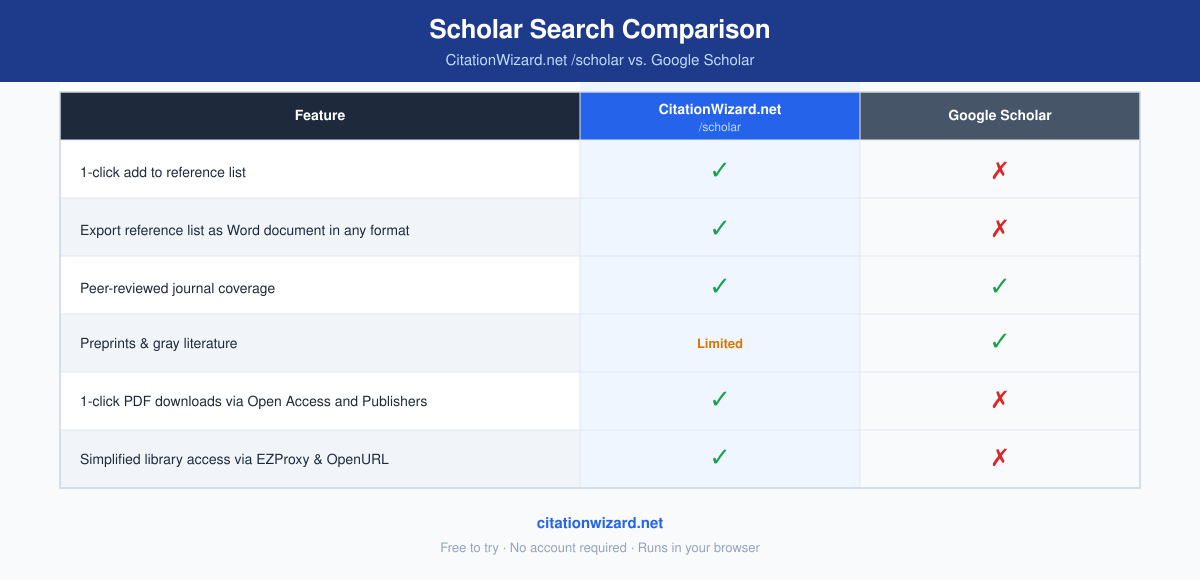
RefRunner’s display is fairly similar to Google Scholar. The difference is what happens next. Click add and the reference is added to your reference list, formatted in your chosen style, with the correct DOI, proper italics, and accurate publication details pulled from Crossref or OpenAlex. One click instead of five, and then copy or download all of the references properly formatted ready to paste into your paper.
RefRunner won’t find everything Google Scholar finds. OpenAlex’s coverage of preprints and gray literature is narrower, but for peer-reviewed journal articles, it’s got what you need and the output is more accurate.
Also, if you’re interested in downloading PDFs of the things you find, again RefRunner saves you some clicks. With Google Scholar, you click the article title, get to the DOI page, then have to search around for where to click to download the PDF. With RefRunner’s search, for Open Access articles, and many publishers, there’s a direct download link, that, before downloading the file, copies the author’s name, year, and article title to your clipboard, so instead of the random digits most publishers give you for a filename, you can simply paste and get a title like “smith-2023-very-important-paper.”
To save time getting articles from your library, RefRunner can be configured to use OpenURL, OpenAthens, and EZproxy systems, keeping you from having to look up the paper again in your library’s search system.
RefRunner is what you would get if your computer geek friend watched what you were doing and optimized everything possible, usually in a way that doesn’t require you to learn anything. At least, that’s what this computer geek has tried to do. I’ve now looked up over 5000 articles from dozens of papers. I have a low tolerance for three clicks when one would do.
Check out the other scholar
You probably use Google Scholar because it’s familiar. The search is good. The citations are a workaround that people accept as the way things are. Take a few minutes and see if RefRunner can save you some time and frustration.