


In a post on LinkedIn Alexander Martin Mussgnug describes how a journal re-wrote his references to his own work and replaced his name with someone else’s. (Hint Alexander Martin is not Anna Maria.)

The article is Open Access, so I retrieved the errant citations and fed them to RefRunner and it fixed them immediately.

It turns out that if you’re actually looking up references rather than trying to imagine what the references might look like, it’s a simple problem. I pulled out several more where names were wrong. Another issue these images highlight is the first-name/last-name order. I think that this is supposed to be formatted as Chicago, which uses firstname-lastname after the first author, but I’m not clear what’s correct. It looks like it’s at least mostly consistently using lastname, firstname all the way through. I’m not able to find an example of a style file that follows Chicago rules that handles authors this way, but since RefRunner uses the same formatting library that Zotero, and most other projects use, it’s not hard to make a style file that works that way.

Don’t trust an unfamiliar computer program to tell you what to do? RefRunner makes it easy for you to make your own informed decisions. Clicking the DOI opens the journal page in a new tab, making it quick to see for sure that Sina, not Siavash is the correct name.
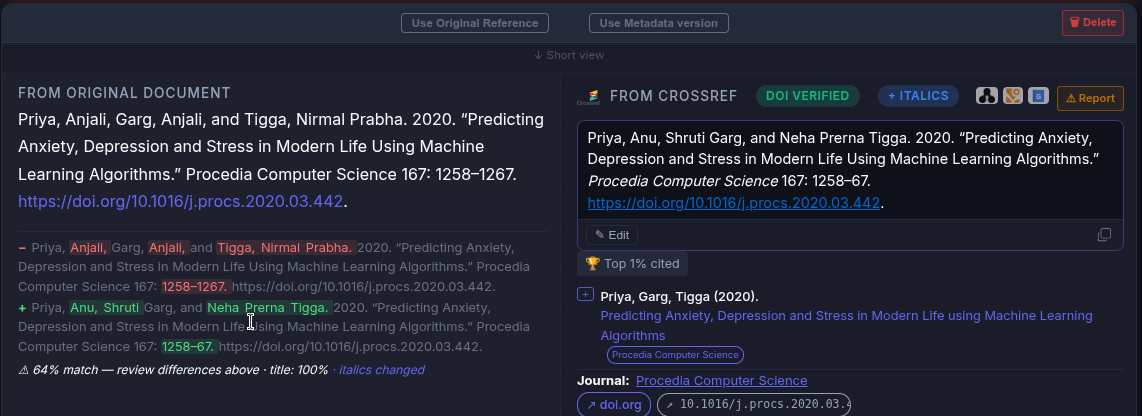
Again, a quick to the DOI shows that indeed, all three author names wrong. It’s Anu, not Anjali. It’s Shruti, not Anjali. It’s Neha Prerna, not Nirmal Prabha. Interesting that the same wrong first name was used for two authors!

One more time, clicking the DOI lets you check that the name really is Salla, not Sofia.
More than just names

The published reference includes the DOI, so we are sure that article they are talking about (and the title matches the DOI data), but the year, volume, and page numbers are incorrect. I’m not quite sure how this might have happened. A legitimate issue often fixed by RefRunner is a pre-print in one year getting assigned a publication year, volume, and page numbers a year or two later. Indeed, this article was first available in 2023, so if the page numbers and volume were missing, then this would be correct (or would have been until sometime in 2025).
What’s the Issue?
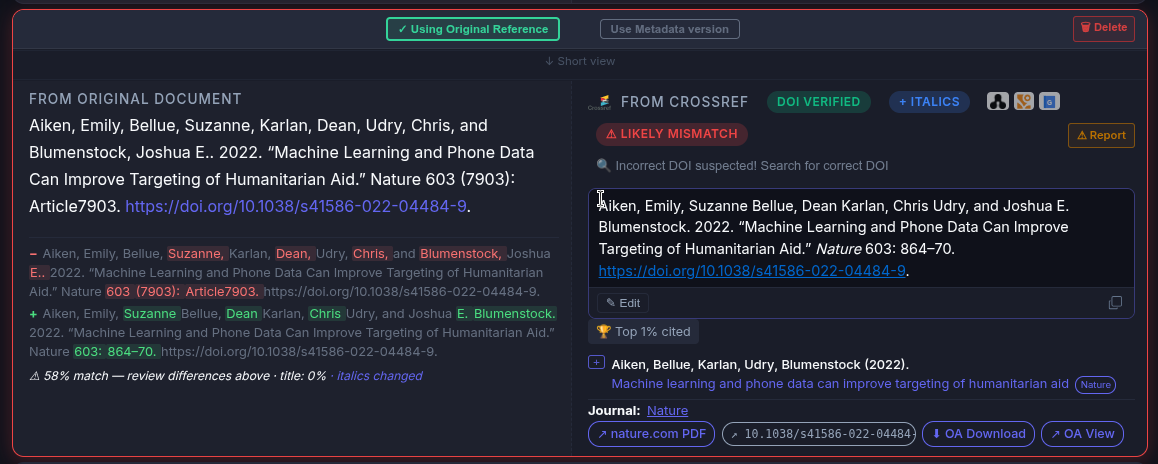
This one surprised me, and in fact, required some work to get RefRunner to handle correctly. Some journals assign sequential issue numbers, separate from the “Volume, Number.” On some journals it’s not to be seen on the web page, but is only in the metadata supplied to Crossref, which you can see here if you’re interested. Also, in these modern times, some journals do away with page numbers altogether and instead assign article numbers. In APA, the proper indication of this is “Article XX”; Chicago instead treats these like the numbers assigned to each numbered issue of a volume (not to be confused with the global Issue number!). Here they’ve assigned the global Issue number both as the number and the article number. They’ve also included “Article,” which it not proper for Chicago formatting, though I’m not clear if this is some custom formatting style. I spent quite a while getting this working correctly for both Chicago and APA. It’s surprising how many edge cases there are in pulling out the metadata to hand over to the formatter! I’m about 10 weeks in to this project and I’m still finding weird cases.
An extra Article
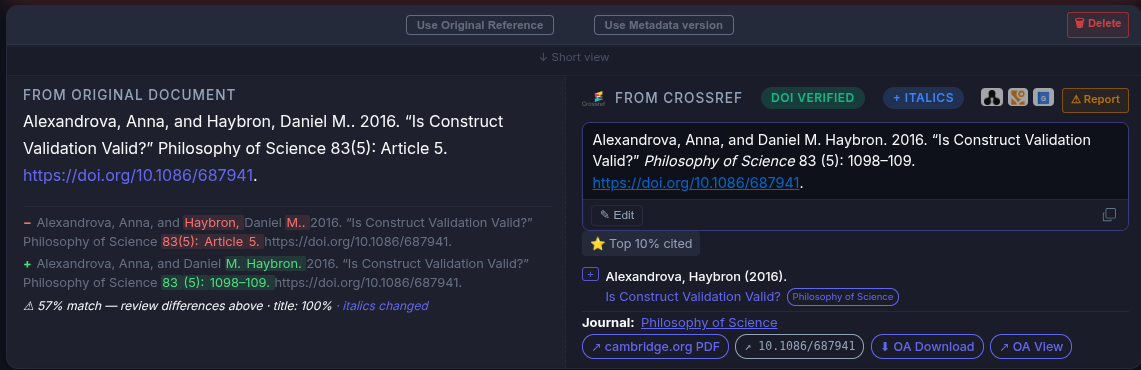
Here’s another case where we have an article number. Again, I’m not clear if the intent is to handle it like APA does, with “Article 5,” or like Chicago does, with “83(5)” (83 is the volume number). I’m pretty sure, though, that doing both is not correct.
Friends don’t let friends use LLMs for references
I’m still surprised how quickly and accurately RefRunner is able to find articles (these were easy since they did have accurate DOIs) and format them correctly. Check it out for yourself! Use this link to get a free month’s subscription.
One of the things that I find most amazing is how quickly it will help find references given just the in-text citations and no reference list at all. You can get an idea how that works with the sample references button on the landing page, but seeing it work with a whole paper’s worth of citations was one of the things that I was most astounded by when I started this project.