

You have to start somewhere. . .
Thus far I have been testing [RefRunner])(https://www.refrunner.com/) with whatever I could find, mostly work from friends working on getting papers and books out the door. I stumbled on a Sample Papers page from the actual APA. They include a Professional sample paper with annotations as comments (DOCX, 104KB) that I thought would be good proof that the Wizard was ready to work some magic. So I got that paper and dropped it on my browser.
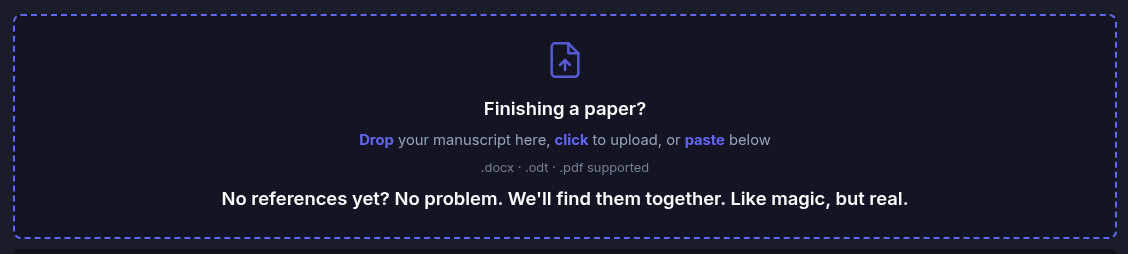
Do my in-text citations match the references?

Find out immediately. I tried to time it, but I didn’t get to even one-mississippi. On my first try, however, there was trouble, because it couldn’t handle multiple author-year papers like “Boysen (2015a),” so those showed up as not having a match. A friend pointed it out in early testing, but he was happy enough with all the stuff that was working and that seemed like an edge case and he didn’t even think to ask.
Are the references really referring to what they claim to be?
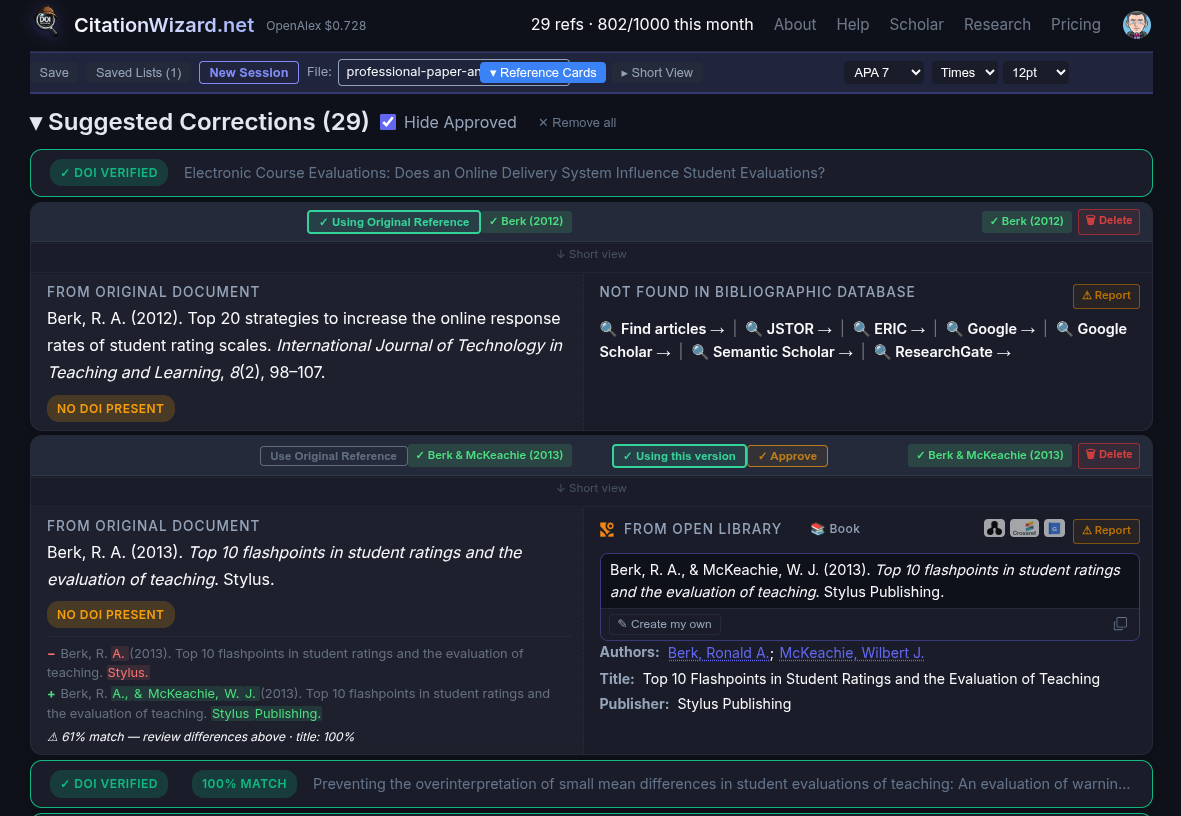
That “Hide Approved” checkbox hides the references that are a perfect match between what was in the file and the reference formatted from the metadata. Your first time you might want to check all of the references, because you might not trust the Wizard any more than you trust anyone else to help with your references. There are some that we need to consider, though. That “Berk (2012)” paper not only has no DOI, it isn’t to be found in Crossref (where most DOI data lives) or OpenAlex, another publicly available database. Given that the point of this APA-provided document is to demonstrate how to cover all kinds of references, it makes good sense that a paper with no DOI is here. If you click the Google Scholar link, it will open a new tab with a search for the title. Google Scholar finds a PDF of the paper on ronberk.com. The PDF looks legit, but I still wasn’t convinced. Clicking the google search link for the journal name finds several more links to the PDF. I edited the Google search to just the journal name and found that International Journal of Technology in Teaching and Learning (IJTTL) is hosted by the Society of International Chinese In Educational Technology. A few more clicks finds the paper on their site. I was unable to find an automated way to track this one down. If you’d cited this yourself, of course, you’d know about the journal and wouldn’t have gone on this particular goose chase.
Books are hard
Next we have Berk (2013). This one is found in openlibrary.org. It lists two authors, adding Wilbert J. McKeachie. Clicking the OpenAlex icon on that card will re-try finding that title in OpenAlex, which finds a DOI and a 2023 publication date. If you click the DOI, you get to the Taylor & Francis page, which shows the 2013 date and 2023 as the ebook date. Sadly, OpenAlex got only the 2023 date in its record.
Books are disappointingly hard to track down in the available public databases. Book data might be in OpenAlex, GoogleBooks, or OpenLibrary, and they might be in more than one. Often books have many publication years, so [RefRunner])(https://www.refrunner.com/) compares the date in the user-supplied reference against all of the publication dates it can find, trying to pick the one that most closely matches your reference. If you don’t like its answer, you can ask it to try again. Clicking the little OpenAlex icon  , initiates a search at OpenAlex, and yields a new card.
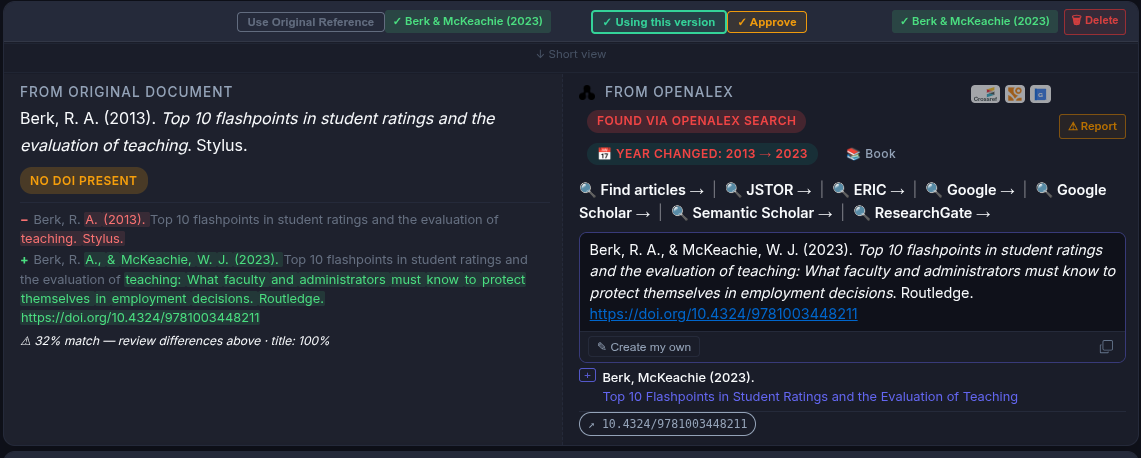
It turns out, now the book is available online and has a DOI. APA says that you are to include a DOI if one is available. We have a DOI, but is this what we want? Often you’re left with a situation like this. Do you want to cite the loved paper copy on your shelf? Do you want to use the DOI to make it easier for other people to find and love the book? [RefRunner])(https://www.refrunner.com/) makes it easy for you to discover that this is a decision that you need to make. It doesn’t make the decision any easier, however. That’s still up to you. (“But what about Amazon?” you might ask, well, sticking the reference in an Amazon search does not find this book!)
You can’t trust books
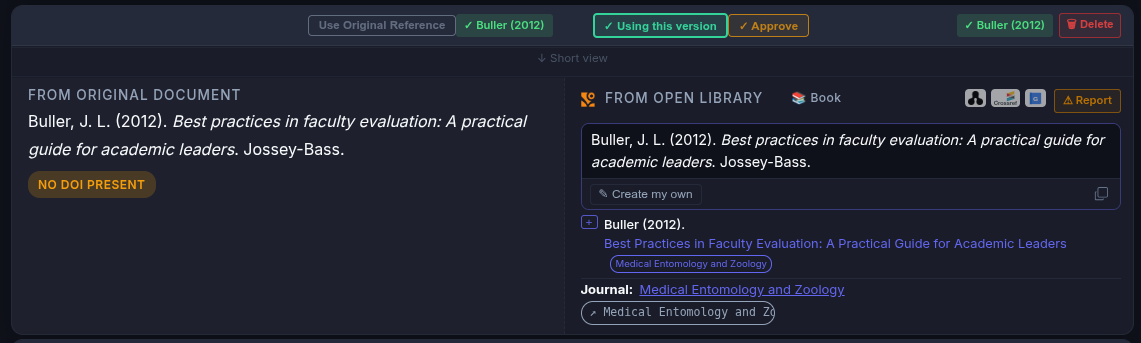
Here’s another book. The Wizard did a good job on this one, though at least right now, I don’t trust any of the book databases enough to not require you to check it, so you have to click that “approve” button. It was in OpenLibrary, but this time the OpenAlex search finds a copy in an obscure (to me) repository in Japan; that’s what that “Medical Entemology and Zoology” link is. I think this repository is similar to eric.ed.gov. I haven’t yet found it helpful, a future revision will filter out these results.
Another journal with no DOI
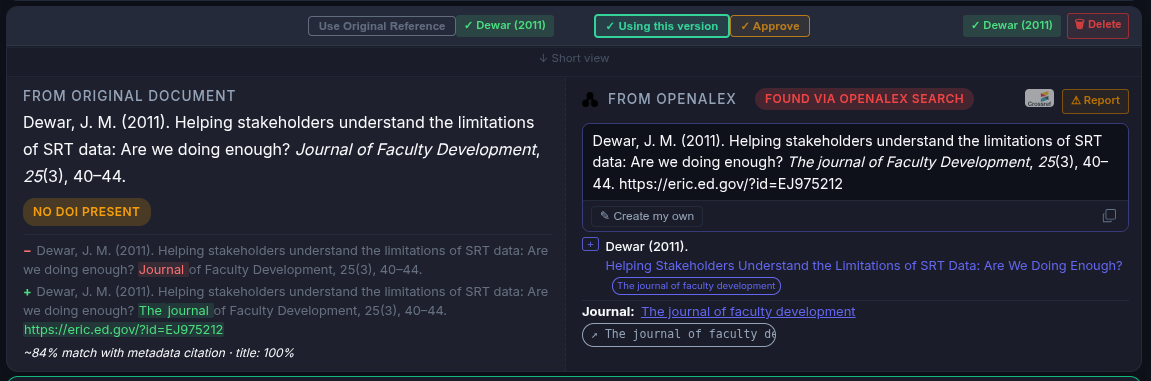
This time it’s in OpenAlex, which got it from ERIC (notice the URL). OpenAlex thinks that it’s The journal of Faculty Development, where our original reference is missing the initial article. I found that the journal has a website (which does not list journal articles, and seems to have shut down in 2016). This definitive source shows the journal title without the definitive article. OpenAlex got it wrong. If I weren’t developing software that was trying to get this stuff perfectly right, I’d be willing to accept that the original reference was correct, without an extra 10 minutes of research. Hopefully, you will too.
When the publication year is not the publication year
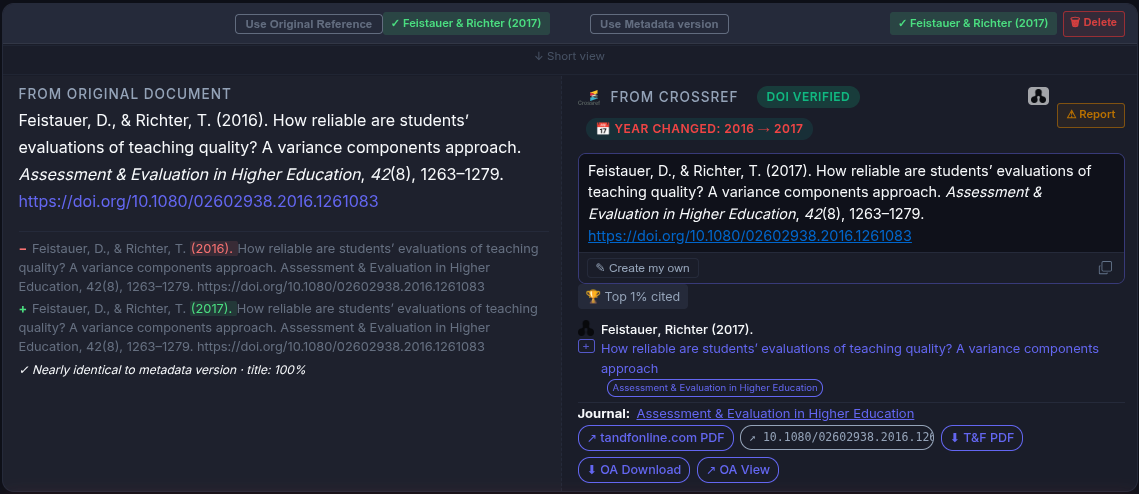
Here’s a favorite of mine. You can see in the diffs on the left that the suggested reference has a different year. There’s a big badge on the right, to make sure that you notice. Everyone wants the year right. The first-available date on this paper was 2016, but when it went to press, it was 2017. This happens for virtually every article published going forward. The Wizard’s magic keeps you from having to look up every such paper every time you prepare your references. Zotero won’t do that for you! If you don’t trust the Wizard without seeing it with your own eyes, just click the DOI button to see exactly where actual DOI takes you.
Journal with a subtitle?
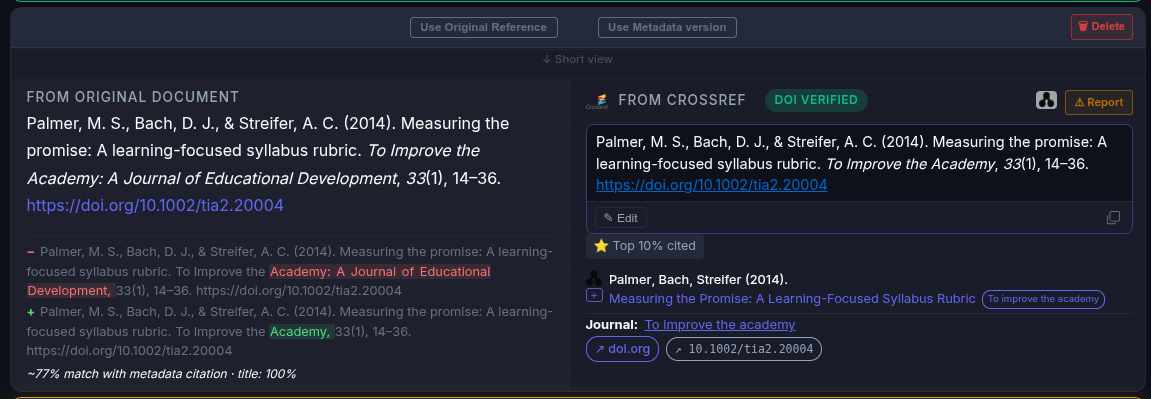
Well, apparently it really is called To Improve the Academy: A Journal of Educational Development, but when they submitted the DOI metadata to crossref, they didn’t include the subtitle as part of the title field. I checked metadta from the most recent article (in 2019) and it too omitted the subtitle.
You can’t always find what you’re looking for
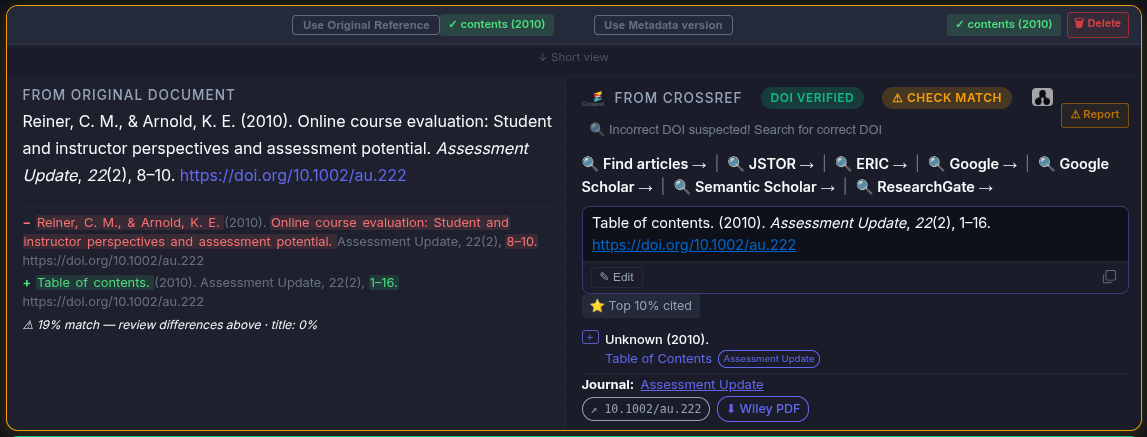
I feel a little cheated on this one. They have a DOI. It exists. It is for the book. But. Crossref, and apparently the publisher, indicate that DOI is for the Table of Contents. I don’t have access to the PDF, but I suspect that the work we’re looking for is indeed on pages 8-10. The DOI appears to be for the whole volume, or maybe only the Table of Contents is in the PDF? I did manage to find an EBSCO link that confirms it’s there. It would seem like Wiley could do better.
Finally, A win for the Wizard!
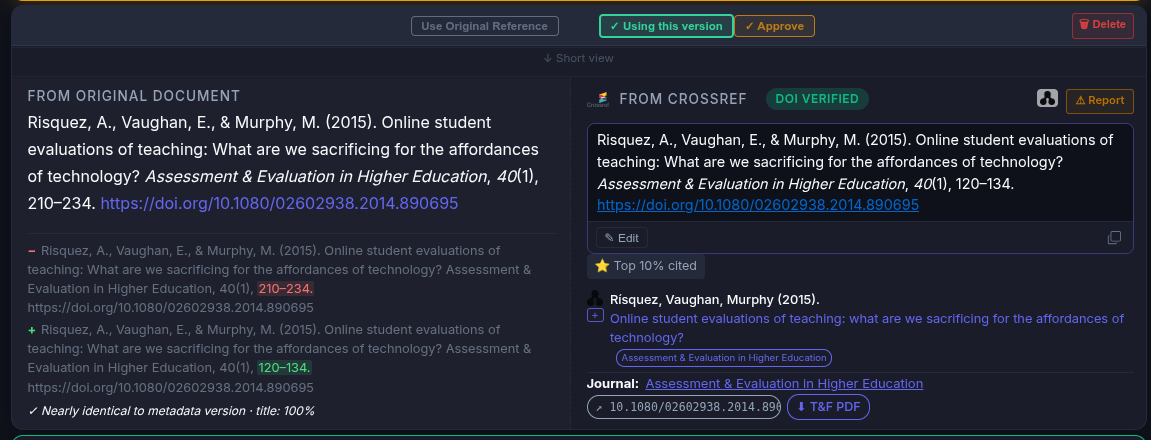
You can quickly see in the red/green letters in the diff section on the left, that there’s a page number disagreement, and this time, the metadata are correct, and our source document has the wrong page numbers. We might guess that they transliterated the first page number—switching the correct 120 to 210—and then they figured that the 134 that they had must be wrong, so they switched it to 234.
A more subtle win? Or maybe this is just annoying
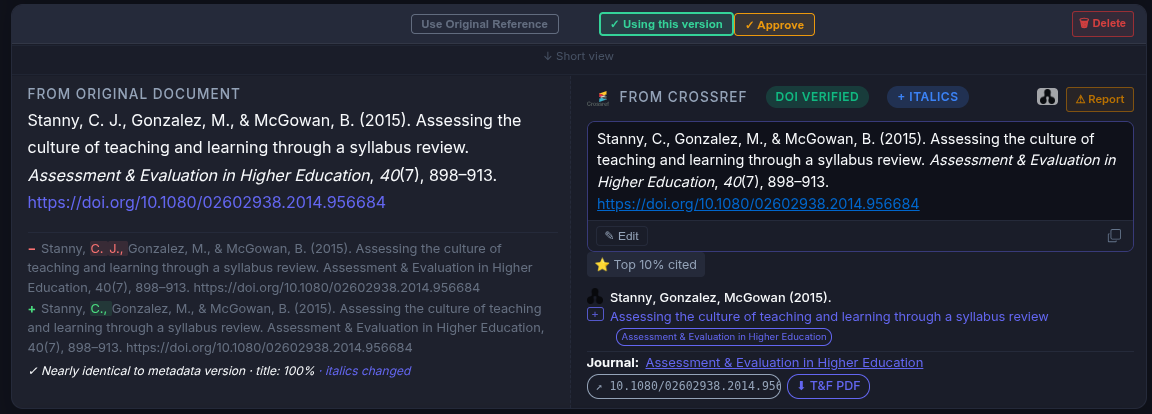
This is subtle, but the kind of thing this type of tool, for better or worse, makes an issue of. I’m not sure which is more correct, including both initials? (I spent much more time than is reasonable to determine an official APA policy on the number of initials to include, but found nothing satisfying.) Only one initial is listed on the publisher’s page for the article. None of the other authors in this reference has multiple initials. Perhaps there are two prominent Stannys whose names both start with C? I’ll call this a draw.
Another win!
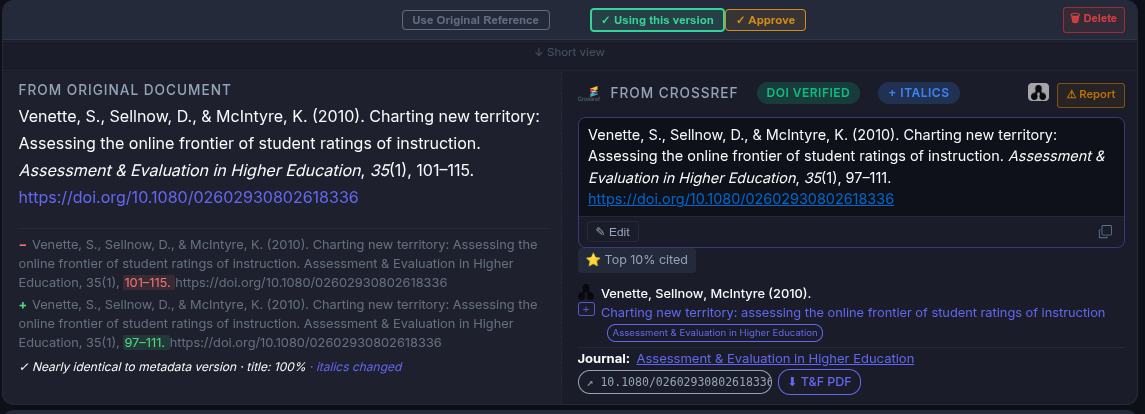
Here’s another example where the Wizard’s attention to detail catches an error in the page numbers. The publisher page is consistent with the Wizard’s recommended correction.
The Wizard doesn’t much like books
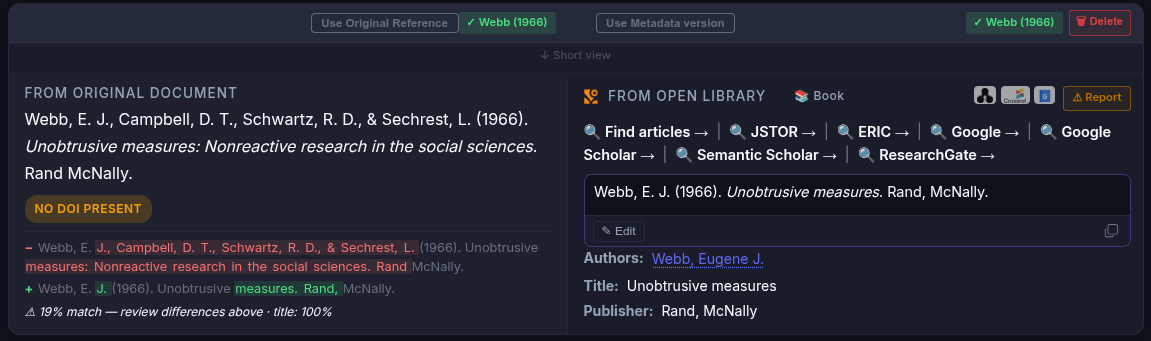
Neither Open Library nor Google Books has all of the authors. OpenAlex finds a book review, which does list all the authors, but thankfully I’ve trained him not to suggest a book review when searching for a book. If this were a reference supplied by someone else, this might be good enough assurance that it was legitimate. Clicking the Google Search link finds a copy of the book on scribd.com. I’ll consider adding a scridb search for old books in the future, perhaps.
We found 3 legitimate errors, out of 29 references. Let the Wizard lend you a hand too!
Out of 29 articles in this reference document, [RefRunner])(https://www.refrunner.com/) matched all the in-text citations to their references, and all but 7 of them (about 25%) were identified in under a minute. There were a few things we couldn’t quickly verify, but we did provide 3 legitimate corrections (10%!), to a document that was carefully produced.
Thanks for reading this! Please use this link to get a free month’s access to RefRunner!